
Features
Some of the features mentioned here are not new to you!
You have seen them before in text and in basic document analysis. We know you have used ChatGPT and Claude.
The bot figures out what you need and decides which data, logic, and tool to use – without you having to specify it. You can describe an outcome, and it works out the right tool, the query, the formula, visualisation configuration, and the output format on its own.
A few Examples
- Create a report to tag employees based on their target achievement this month as poor, good, or excellent
- Change the above calculation to be based on sales quantity
- Convert this to pie chart
Follow-up instructions and questions work without having to start over. The system understands that each new message is in the context of the previous one — you don’t restate the full question every time.
A few Examples
- Please add an email field to this report
- Use GrossSales and update the result
- I want to see this in a horizontal chart, do that

Yes, LLMs have world knowledge, but you have internal acronyms in the company. Configure them in SmartenBoT. It understands synonyms, business-specific terms, and vague language. Maps informal or colloquial terms to the correct columns and values in your dataset without you having to use exact field names.
A few Examples
- Show sales for beverages - correctly returns coke, soda, tea
- Filter for only TopDeps - TopDeps is your internal business term and it will filter for that.

It picks up important variables from your conversation that apply across the entire session. Business-specific definitions, currency formatting, filters and formula preferences are remembered and applied to every subsequent query.
A few Examples
- Always use GrossSales when I say revenue or sales
- Format the currency numbers in Euros only
- Calculate attrition rate as (Employees Left ÷ Average Headcount) × 100

Answers questions that combine your data with general knowledge. It can apply external context – geography, population, industry benchmarks – to filter or interpret your data without that context being in the dataset
A few Examples
- Show sales only for the states with high population - know which states qualify without it being in the data
- What do you think? How should we calculate CAGR based on what's available in this data? - discusses the logic before running it
- Please show the average discount by products in western states
Every result comes with an explanation of the logic used, the assumptions made, and a transparency note where the system has approximated or worked around missing data. You know not just what the answer is but how it was reached.
A few Examples
- For calculating target achievement, I have used the total_target / total_sales formula...
- The current result may not reflect what you asked because the required columns don't exist, but I have calculated using..
- I have used SalesPrice - ListPrice to calculate Discount because discount isn't directly available in the dataset
After every response, the system suggests contextual next questions based on the current exchange and the dataset metadata. Not generic prompts – specific and relevant to where the conversation is right now.
A few Examples
- Break this result down by city and employees
- Compare this figure with the previous year
- Just show this for Arizona
- Limit this result to top 5 only

Doesn’t fail on bad spelling, typos, or phonetic approximations of product names, places, or people. Critical for mobile use and voice-to-text input scenarios where exact spelling is unreliable.
A few Examples
- pressuree kooker x334 - understood and resolved correctly
- Phonix, AZ - resolved to Phoenix, AZ
- Show presur kooker sales in this quarter

Understands cultural and seasonal references and maps them to date ranges in the data. Works across Indian, Western, and regional calendars – useful for FMCG, retail, and any business where seasonality matters.
A few Examples
- Who sold the most alcoholic drinks in Phoenix, AZ in the Diwali of 2015?
- Compare total sales during this summer vs last summer for ice cream
- Which sales rep sold the most cake during April 2015 to May 2016?
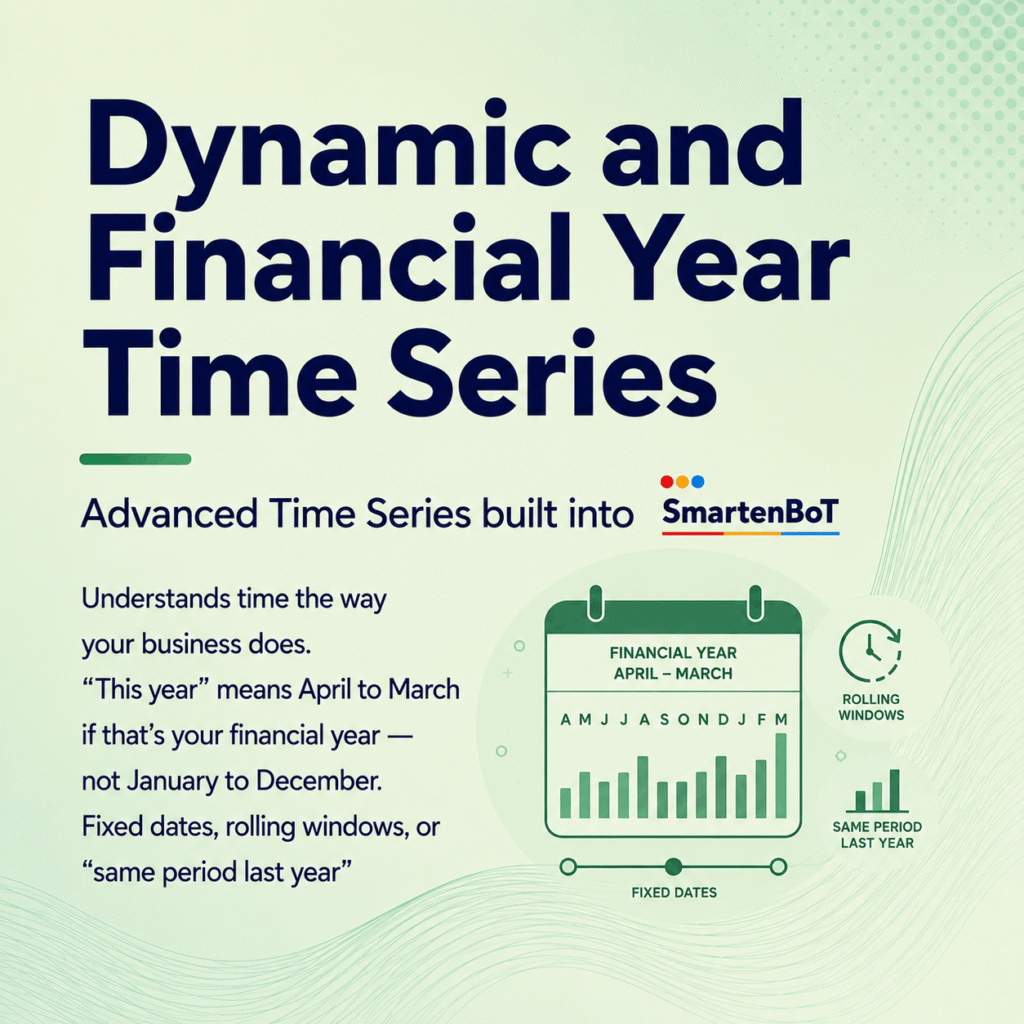
Handles absolute, relative, and dynamic date ranges. Performs calculations based on the financial year configured for the dataset – so “this year” means the right thing even if your year runs April to March.
A few Examples
- Compare sales from this financial year vs last for beverages
- What is William Jones's best-selling product for this year?
- Which sales rep sold the most cake during April 2015 to May 2016?
Ask questions across multiple separate datasets without first preparing a combined dataset or even selections dataset(s). The system identifies which datasets are needed and joins them automatically to answer the question.
A few Examples
- Highest target achievement percentage for each employee in Arkansas - joins SalesData and EmployeeTable automatically
- Identify the carrier with the highest average departure delay on days where precipitation exceeds the 90th percentile - joins flight and weather data
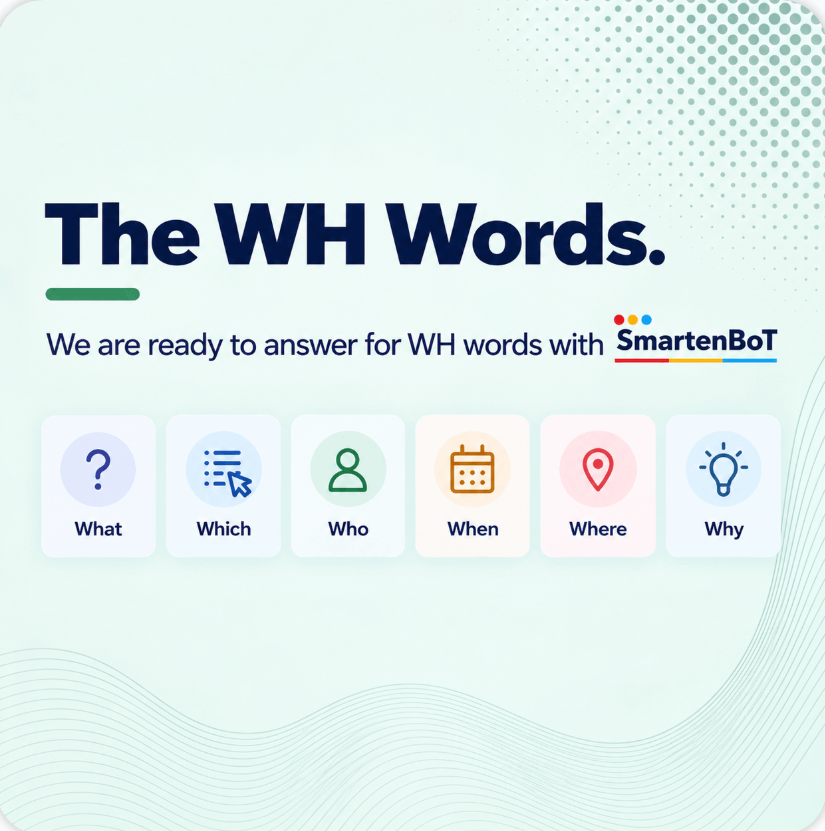
Handles computationally complex queries in natural language, including multi-step formulas, rankings, segmentations, and the full range of WH questions – What, Which, Who, When, Where, and increasingly Why.
A few Examples
- What is the RFM score for each customer, and segment them into high, moderate, and low value
- When did Sybil Johnson sell the most noodles?
- What does Bobby Jones sell well?
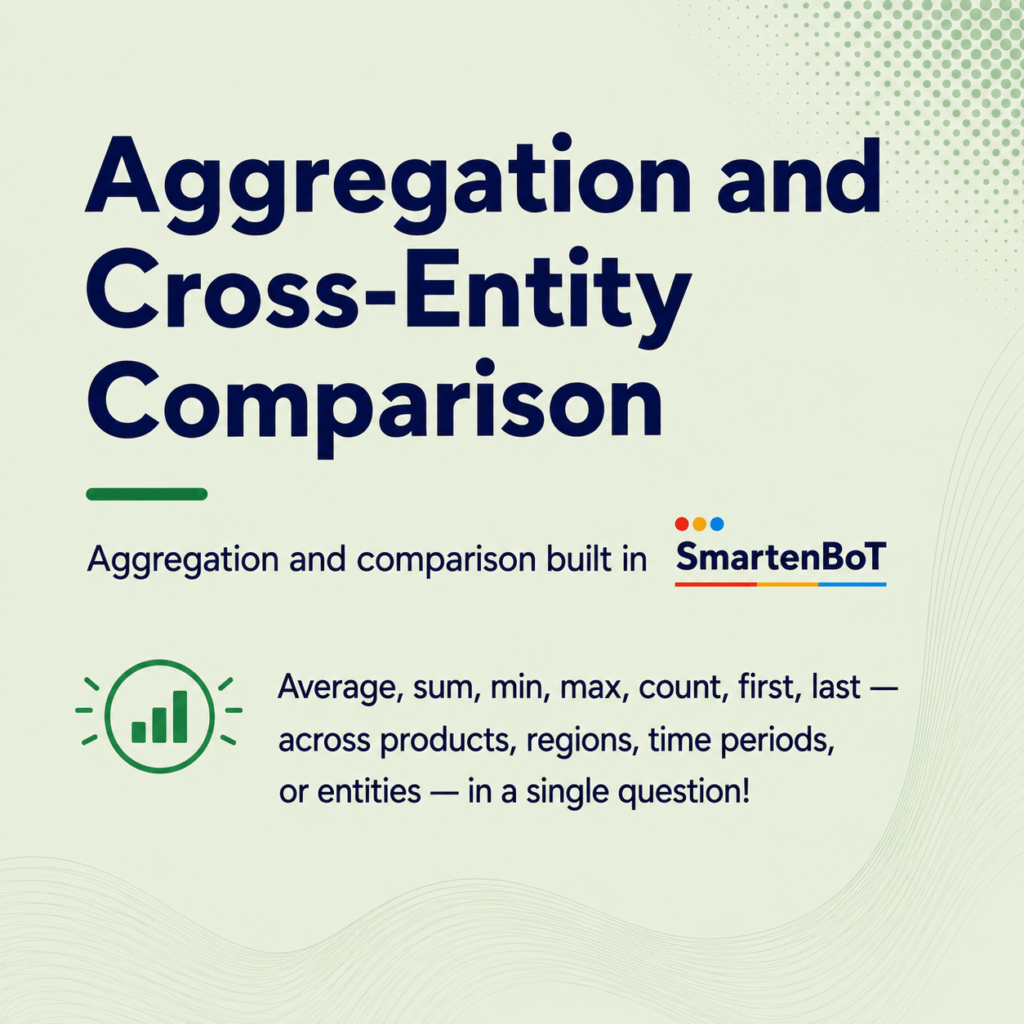
Average, Min, Max, Sum, First, Last, Count, and most/least recent aggregations, with the ability to compare across time periods or across entities in a single question.
A few Examples
- What is the average list price for ginger tea in the Western region?
- What is the cost of goods for ice cream products in Arizona vs Arkansas?
- What is the most recent stock value in West Godown?
- Last month closing stock across all godowns
Understands whether higher or lower is better for a given column, and applies that understanding when ranking or evaluating performance – without you having to define it every time. This is a critical feature. Polarity is a key interpretation!
A few Examples
- How are we doing in terms of profitability? Understands profitability should be higher for it to be good
- What is the status of the old stock? Will figure out that old stock is not good for business.
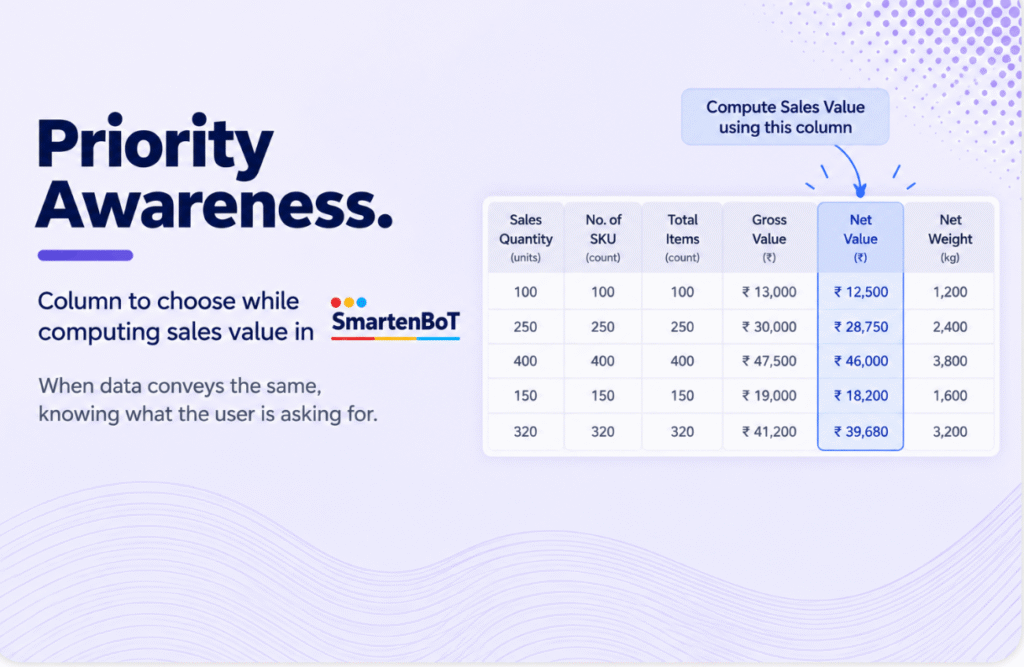
Columns in datasets often look the same but can be dramatically different. List price, Price with Tax, Discount, Price after discount, Price after coupon, price per item for the SKU, price per SKU, Gross Margin and Net Margin and much more. When you ask a question about the price, which column takes precedence over the other when the answer and analysis are generated? The same applies to many things in sales, inventory management and logistics, among others. SmartenBoT determines which column takes precedence over the other in the context of the question.
A few Examples
- List the top 10 most profitable products? It will use Net Margin to sort profitability.
- What is the trend in the price of our Bakery products over the last 3 years? Will pick up the list price to make the trend analysis.

Accepts natural language questions in Hindi, Gujarati, Spanish, and other languages beyond English. Ready for Devanagari script, Gujarati script, and Spanish; more to come.
A few Examples
- पिछले महीने किस कर्मचारी ने सबसे अधिक लक्ष्य हासिल किया? (Hindi)
- શિયાળાના દિવસોમાં મારું વેચाण કેટলું હોય છે? (Gujarati)
- ¿Quién vendió más bebidas durante el último trimestre de 2015? (Spanish)

Resolves place names and person references intelligently – including regional groupings, partial names, and culturally specific geographies – without needing exact column values as input.
A few Examples
- Show average discount by products in Western states - resolves Western states correctly
- Who sold the most fruit juice in Phoenix in Q1 2015? - matches city to column values and resolves Who to person column
- Which airline is best for LA to JFK in winter? - resolves route and season
Auto-generates a plain-language interpretation alongside any result – explaining what the numbers mean, what’s notable, and what changed. The result is never just a table – it always comes with a readable summary.
A few Examples
- Ohio leads in revenue this quarter at ₹1.2 crore...
- Audio Equipment is the top-performing category, up 18% on the previous quarter
- The current result shows a declining trend in the Western region over the last three months

The bot can be configured with domain-specific terminology, business rules, synonym libraries, formula definitions, and an industry-appropriate environment. The same underlying engine behaves like a specialist for ERP, HRMS, finance, retail, or any other vertical.
A few Examples
- An HRMS deployment uses attrition, headcount, and appraisal terminology by default
- Custom synonym libraries mean field names in your database don't have to match the business terms your team uses
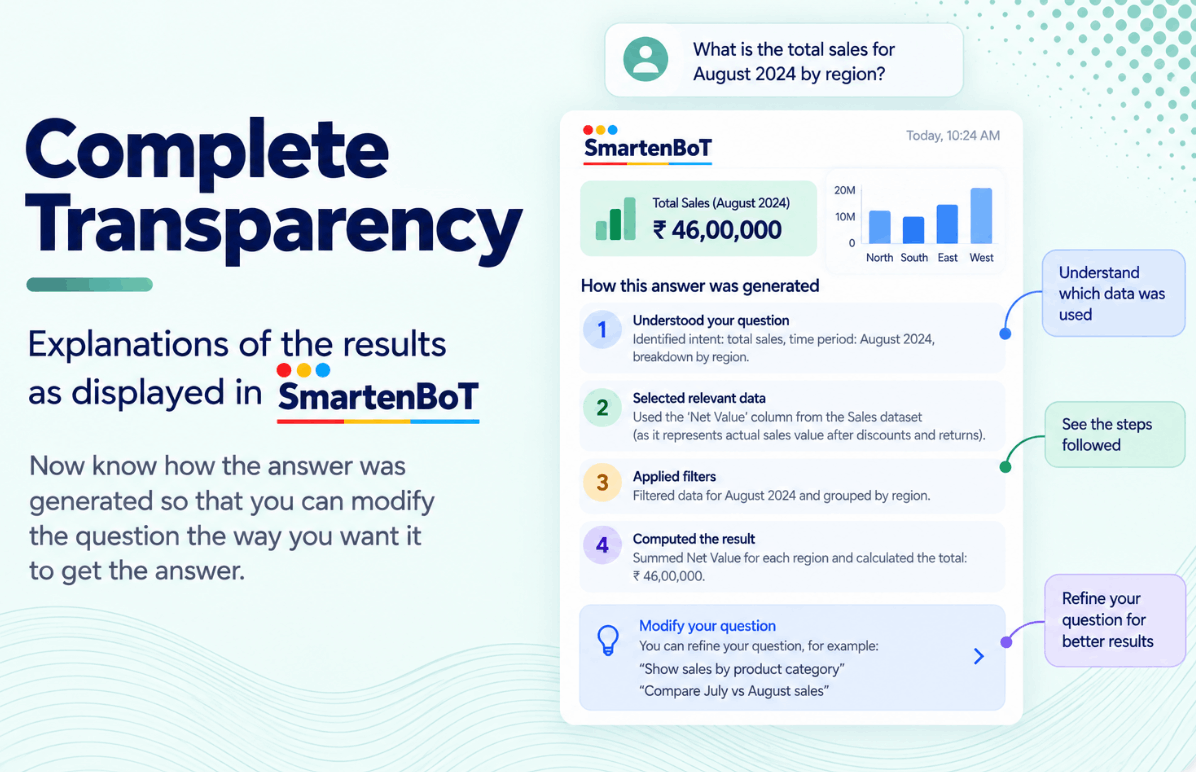
Every response surfaces what the system did, what assumptions it made, and where it approximated. If the exact columns don’t exist, it says so and explains what it used instead. This makes outputs auditable and trustworthy in business-critical and regulated contexts.
A few Examples
- I have used SalesPrice - ListPrice to calculate Discount because a discount column is not directly available
- The result may not exactly reflect your question because the required columns don't exist - here is what I used instead
- For calculating target achievement, I used total_target / total_sales - let me know if you want a different formula
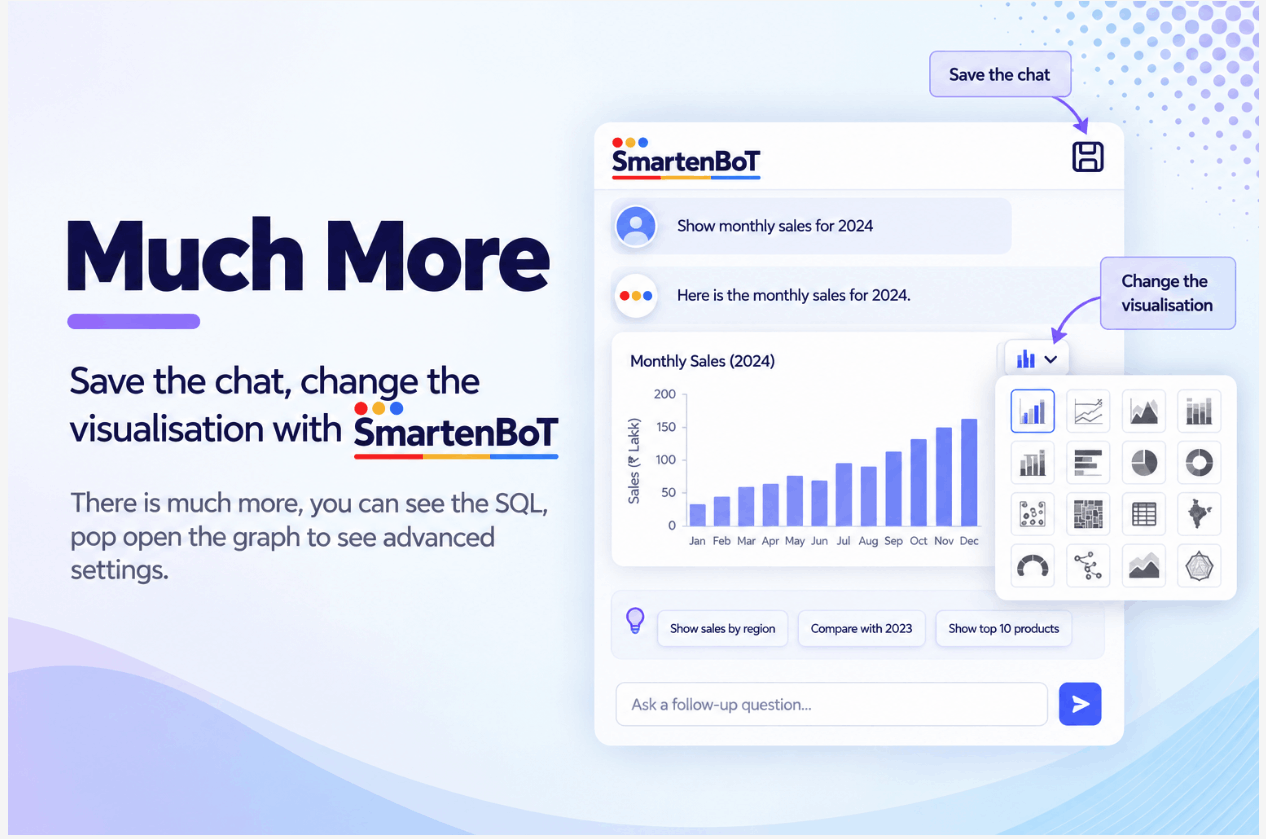
SmartenBoT has many features which will help you use the platform effectively. Like a complete panel where you can maintain your business dictionary, you can open a graph into a powerful visualization layer and edit each aspect of the graph. You can save the chat and return to it later